Table of Contents
Every ecommerce owner eventually asks whether the next pound should go into SEO or into ads. Both bring shoppers to your store, but they behave very differently over time, and the better ROI depends on your margins, your stage and how long you can wait.
This guide compares ecommerce SEO vs paid ads on cost, speed and return, shows when each one wins, and explains how to split your budget. It is written for store owners who want a decision based on profit, not opinion.
📌 TL;DR:
- Paid ads deliver traffic and sales quickly, but they stop the day the budget stops.
- Ecommerce SEO takes months to build, then keeps earning without a cost for every click.
- The better ROI depends on your profit margin, your timeline and how much cash you can invest upfront.
- Most online stores do best using ads for early and seasonal sales and SEO for long-term growth.
- Judge both channels on profit and payback, not on clicks or rankings.
How Do Ecommerce SEO and Paid Ads Differ?
Paid ads buy visibility for as long as you pay, while SEO earns visibility that stays after the work is done. That single difference drives almost every other contrast between them.
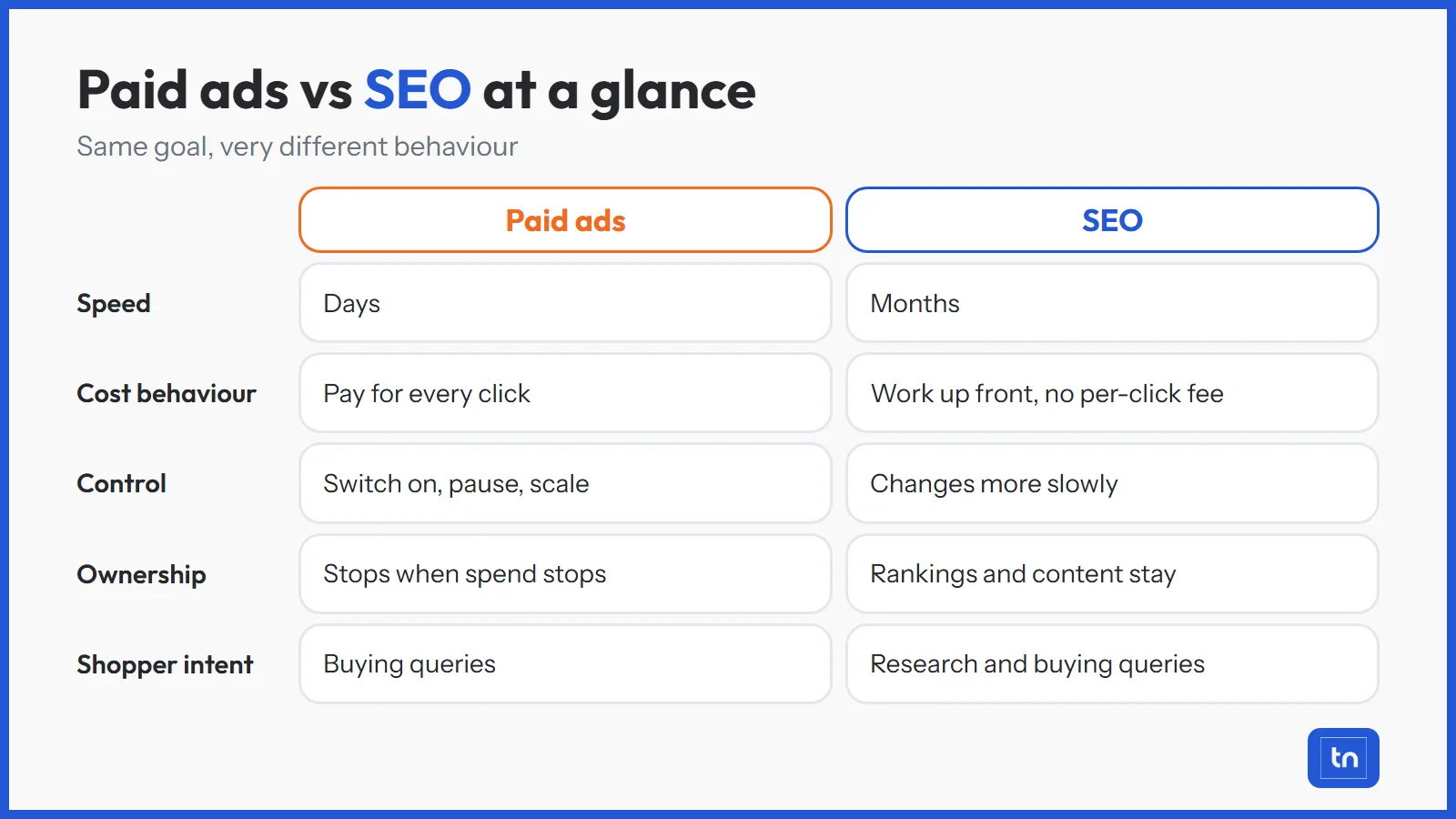
- Speed: ads can bring traffic within days, while SEO usually takes months to build.
- Cost behaviour: ads charge for every click, while SEO costs work up front and then keeps earning without a per-click fee.
- Control: ads can be switched on, paused or scaled quickly, while SEO changes more slowly.
- Ownership: when ad spend stops, the traffic stops, while rankings and content remain your assets.
- Shopper intent: ads target buying queries directly, while SEO also reaches shoppers who are still researching.
How Does ROI Differ Between SEO and Paid Ads?
Paid ads have a steady, measurable return that stays tied to spend, while SEO has a delayed return that grows over time. Neither is always better, because the numbers depend on your margins and timeline.
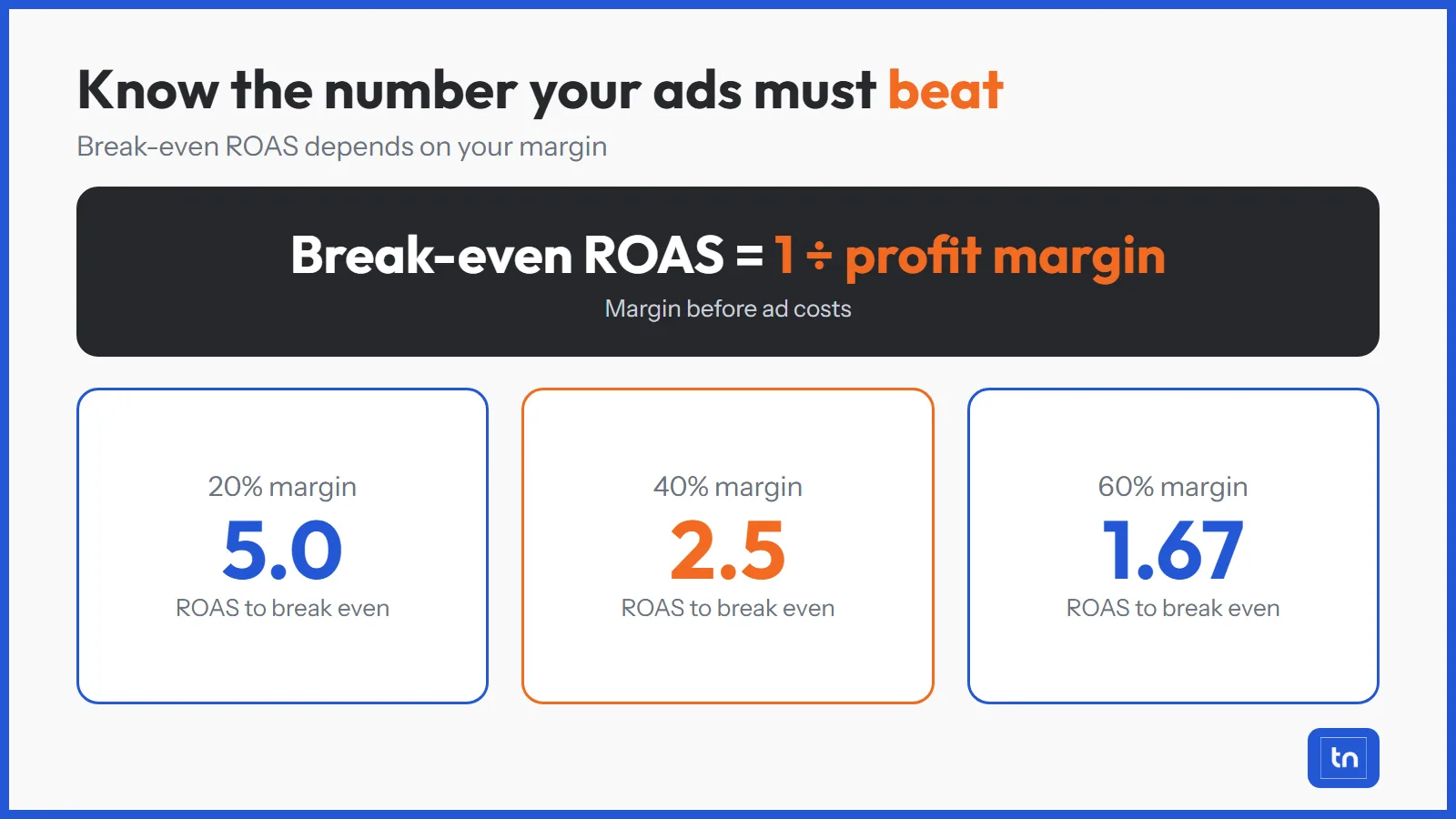
Start with a fair measure. ROAS is revenue divided by ad spend, and it ignores your costs. ROI looks at profit. A useful check is break-even ROAS, which equals 1 divided by your profit margin before ad costs. A store with a 40% margin needs a ROAS of 2.5 just to break even.
- Paid ads: you pay for every click, so a rise in competition or cost per click lowers your margin directly.
- SEO: you invest first, with no guaranteed return in the early months, but cost per sale tends to fall as rankings build.
- Payback period: ads usually pay back sooner, while SEO pays back later and can return more over a longer period.
When Do Paid Ads Make More Sense?
Paid ads make more sense when you need sales now or want to test something quickly. Their speed and control are their strongest advantages.
- You are launching a new store with no search visibility yet.
- You run a seasonal or time limited promotion.
- You want to test a new product or price before committing to SEO content.
- You need to clear stock quickly.
- Your margins comfortably cover the cost of each click.
When Does Ecommerce SEO Make More Sense?
Ecommerce SEO makes more sense when you want sales that do not depend on a constant ad budget. It suits stores with steady demand for their categories and the patience to build.
- Your products are searched for all year, not only in one season.
- Your margins are tight and rising click costs would erase your profit.
- You want to reach shoppers early in their research, before they compare stores.
- You want a lower cost per sale over time.
- You want your visibility to hold up if you pause advertising.
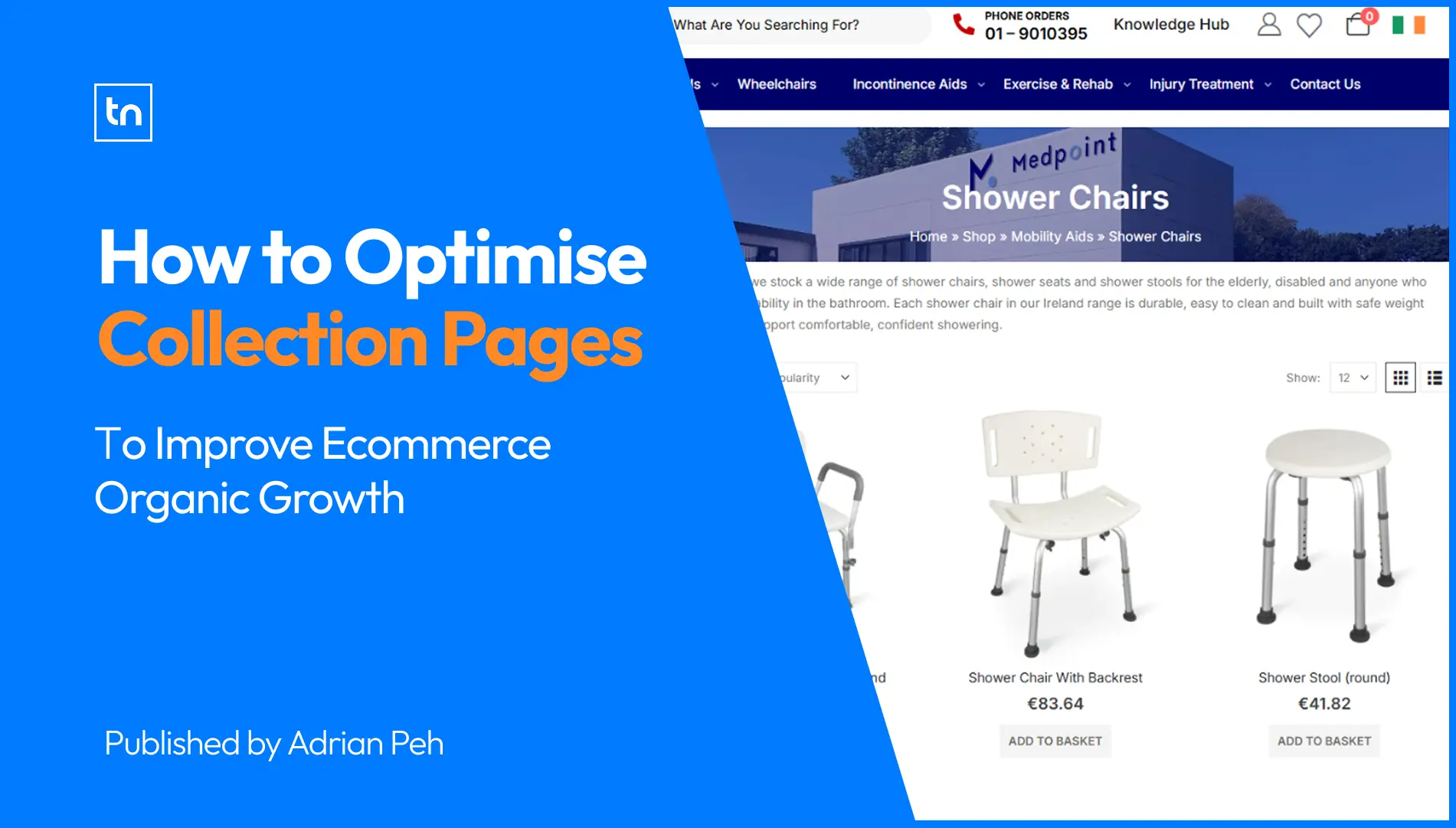
Strong collection pages are the foundation. Our guide on how to optimise collection pages shows how they earn commercial searches.
What Do Real Stores Show About Using Both?
Real results show that the two channels work well together. An Australian hamper and gift store in our Shopify case study had seen a steady decline in organic traffic. After the keyword strategy was realigned and internal linking improved, the case study reports:
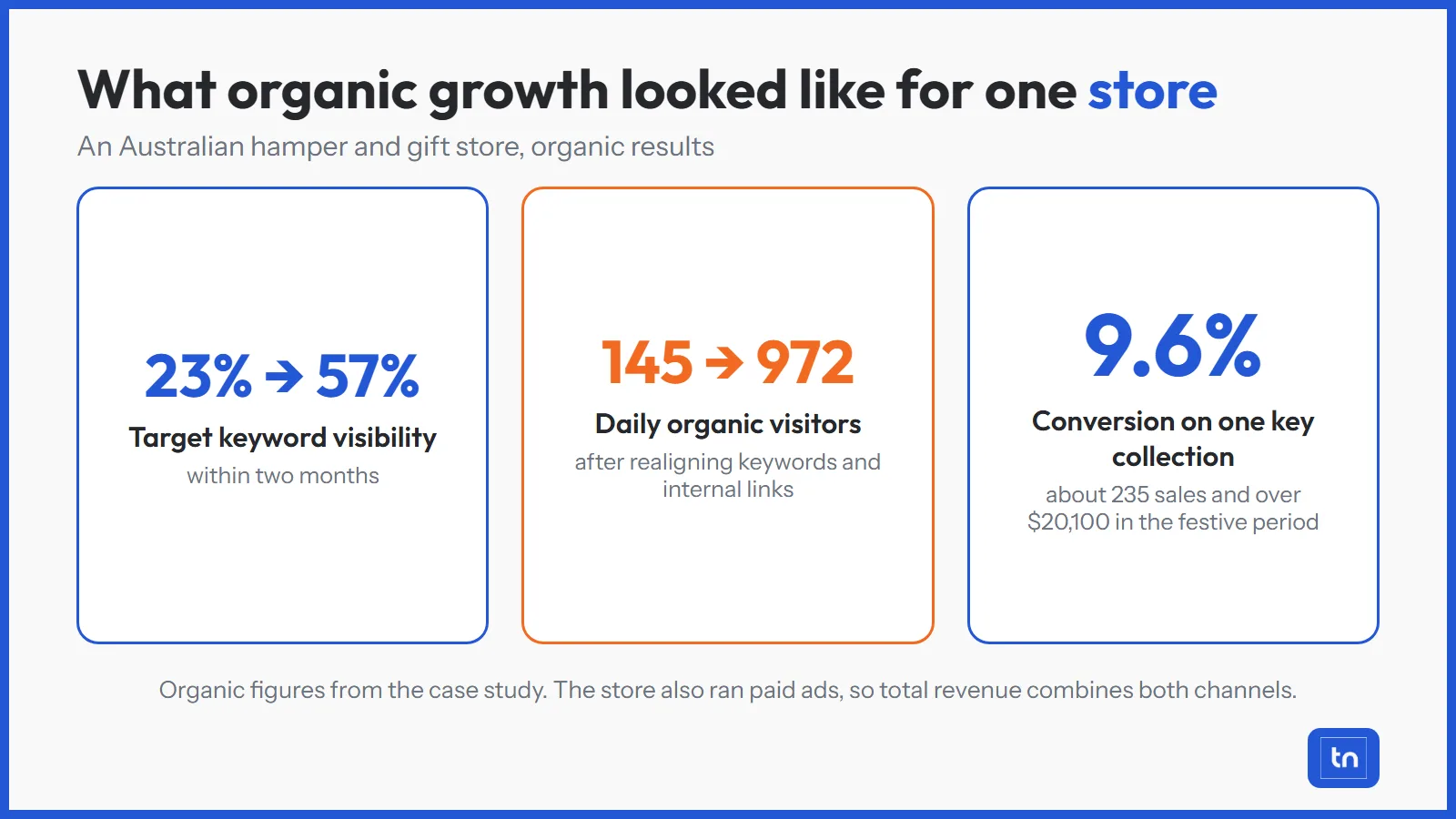
- Target keyword visibility rising from 23% to 57% within two months.
- Daily organic traffic rising from 145 to 972 visitors.
- About 2,400 organic visitors to one key collection page in the festive period, converting at 9.6% into around 235 sales and over $20,100 in revenue.
The store also ran paid ads, and the case study states that its total December 2025 revenue of about $1.2 million combined both channels. The organic figures above come from SEO alone, and the paid and organic results should not be added together.
How Should You Split Your Budget Between SEO and Paid Ads?
Split your budget by goal and timeline, then adjust as the data comes in. There is no fixed ratio that fits every store.
- Work out your break-even. Calculate break-even ROAS from your real margin so you know what ads must return.
- Use ads for early sales. Fund paid campaigns on your best converting products while SEO builds.
- Invest in SEO foundations. Put steady budget into technical health and collection pages so they compound.
- Share the data. Use paid search terms that convert to choose SEO targets, and use organic rankings to see where ads are paying for traffic you could earn.
- Review monthly. Track profit and payback per channel, then move budget towards the one earning more.
An ecommerce SEO agency can map this split to your margins and catalogue, and our SEO strategy services cover the planning side.
How Does AI Search Change the Comparison?
AI summaries answer more questions without a click, which can reduce organic clicks on informational searches and make paid placements more visible at the top of the page. Stores that appear in AI answers still win attention. Our AI SEO services focus on that visibility, and it adds to the case for investing in SEO rather than relying only on paid clicks.
Conclusion
The ecommerce SEO vs paid ads question has no single winner. Ads give you speed and control. SEO gives you compounding returns and lower costs per sale over time. The stores that grow most steadily match each channel to a job and measure both on profit.
If your margins are thin and your products sell all year, lean towards SEO. If you need sales this month, use ads while the foundations build. Either way, check the numbers before you commit the budget.
Frequently Asked Questions
SEO is usually better for long-term cost per sale, and paid ads are better for speed and control. Neither is better in every case. The right choice depends on your margins, your timeline and how much you can invest before seeing a return.
There is no single good number, because it depends on your profit margin. Work out your break-even ROAS by dividing 1 by your margin before ad costs. Any return above that break-even point is profit, and the further above it, the better.
Yes. SEO still brings shoppers who are researching and ready to buy, and AI platforms draw on pages that rank and earn trust. The channel has changed shape, so stores need clear, helpful content as well as strong technical health.
No. AI summaries answer some queries without a click, but they cite and learn from web pages, so visibility still starts with strong SEO. The work now includes being a clear, trusted source that AI answers can name.
Paid ads, email marketing, social media, influencer partnerships and marketplaces all bring traffic and sales. Most work best alongside SEO and not instead of it, because SEO provides steady demand that does not stop when a budget does.